Why Experienced Maritime Engineers Are Difficult to Recruit in the Netherlands
The Challenge Is Finding the Right Experience
Finding an engineer and finding an engineer with relevant shipbuilding experience are not always the same thing.
For Dutch shipyards, marine system integrators and offshore engineering companies, the difference can be significant.
A candidate may have a strong background in electrical engineering, automation or mechanical design. But has that person worked with vessel systems, marine equipment, shipyard production or commissioning projects?
This is where recruitment becomes more specialised.
A Technical Labour Market That Remains Tight
The Netherlands continues to face recruitment challenges in technical occupations.
According to UWV, the labour market remained tight in the first quarter of 2026, with electrical engineering among the occupations experiencing significant shortages.
Although the broader labour market has gradually cooled, finding suitable technical professionals remains difficult for many employers.
For maritime companies, the challenge can be even more specific because individual projects require particular combinations of engineering knowledge, practical experience and industry familiarity.
Why Maritime Experience Matters
Consider a marine electrical engineering vacancy.
Knowledge of EPLAN or electrical design may be an important requirement. However, the actual position might also involve:
- Marine power distribution and switchboards
- Vessel automation and control systems
- Integration of equipment from multiple suppliers
- Classification requirements and technical documentation
- Factory testing, commissioning and troubleshooting
Not every industrial electrical engineer will have experience in these environments.
The same applies to naval architects, structural engineers, production engineers, project managers and marine mechanical specialists.
The professional title alone rarely tells the whole story.
Looking Beyond the Dutch Labour Market
European talent markets provide an additional sourcing opportunity.
Countries with established shipbuilding, marine engineering and offshore industries may offer experienced professionals whose technical backgrounds are relevant to Dutch projects.
However, identifying someone with suitable experience is only the beginning.
Before a candidate can realistically be considered, employers and recruiters also need to understand their interest in the opportunity, work rights, language capabilities, relocation preferences and availability.
These are practical requirements that should be verified, not assumed.
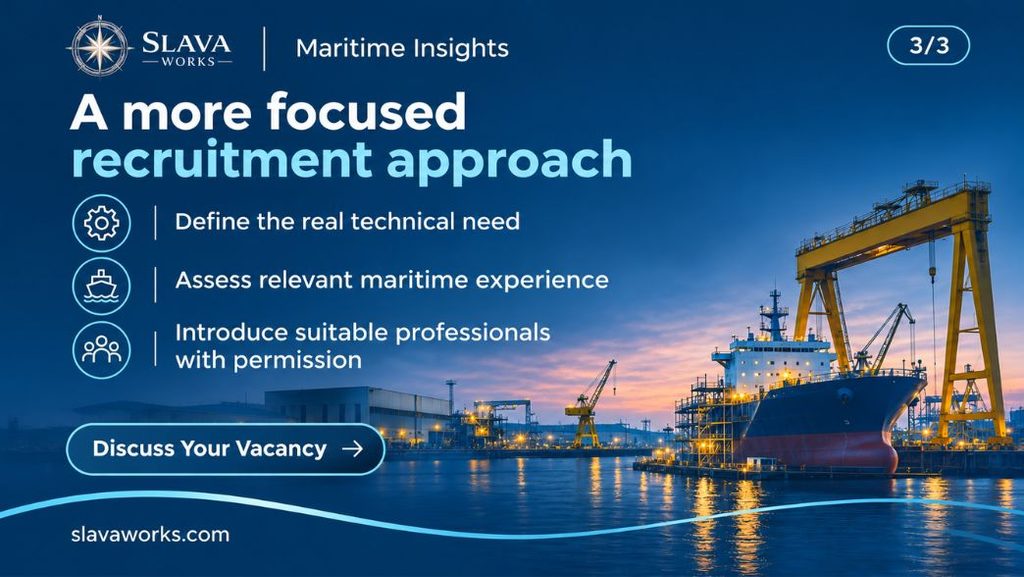
A More Focused Recruitment Approach
A productive recruitment process starts with understanding the position beyond its job title.
What type of vessel or project is involved? Which technical systems matter most? What experience is essential, and where could related engineering expertise be acceptable?
These questions help distinguish genuinely relevant professionals from candidates who simply match a list of keywords.
At SlavaWorks, our approach is based on researching European maritime expertise and assessing its relevance to the technical hiring needs of employers in the Netherlands and Belgium.
We focus on quality, technical relevance and direct recruitment for permanent positions.
Planning Your Next Maritime Engineering Hire?
Whether you are recruiting a marine electrical engineer, naval architect, technical project manager or another experienced maritime specialist, a clear understanding of the technical requirements is the starting point.
Tell us about your engineering requirements and the experience your project needs.
Sources & Further Reading
- UWV — Spanningsindicator: arbeidsmarkt koelt verder af (5 June 2026)
- UWV — Werkgevers leiden vaker nieuw personeel op door aanhoudende krapte (18 February 2026)
- Rijksoverheid — Maritieme Monitor 2025 (4 December 2025)