Maritime Engineering Recruitment: Skills vs Job Titles
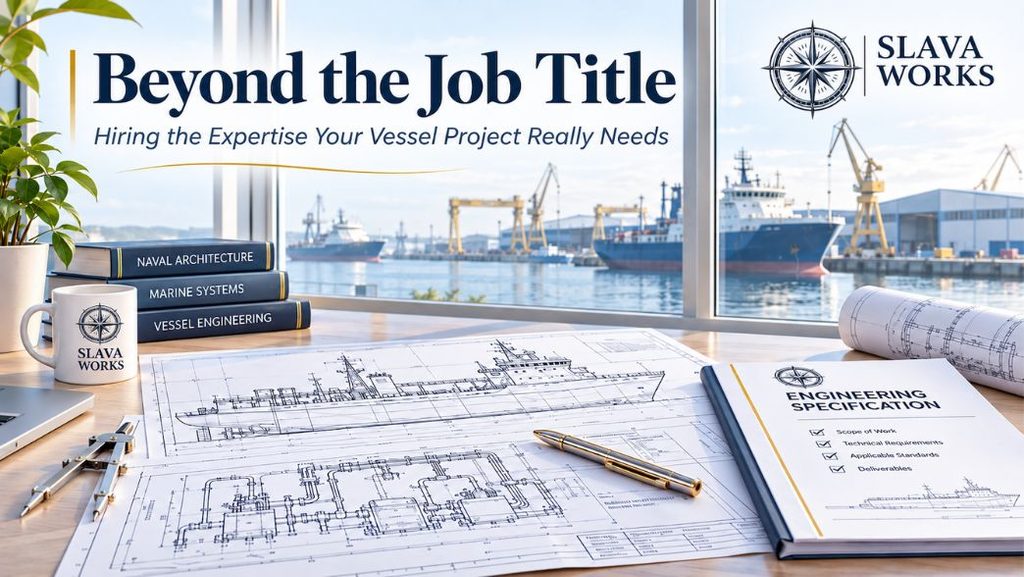
Are You Hiring a Job Title — or the Expertise Your Vessel Project Really Needs?
A practical hiring guide for maritime and offshore employers: how to define engineering requirements, assess real project experience and create a better match for both the company and the professional.
A familiar job title does not always mean a familiar skill set
Two engineers may have the same job title, comparable education and ten years of professional experience — yet be prepared for very different responsibilities.
Consider the title Electrical Engineer.
One professional may specialise in electrical schematics, EPLAN and control cabinet design. Another may have extensive experience integrating electrical systems on board vessels. A third may focus on testing, troubleshooting and commissioning hybrid propulsion systems.
All three may be competent engineers.
But they are not necessarily interchangeable.
In maritime engineering, the difference between general technical knowledge and experience directly relevant to a vessel project deserves careful attention.
For employers, the challenge is not simply to find someone with an appropriate job title.
It is to identify the expertise required to deliver the work.
1. Start with the engineering problem, not the vacancy title
Before publishing a vacancy, the hiring manager and recruitment team should agree on the work the new engineer will actually perform.
A useful starting point is to answer five questions:
- What is the project environment? A newbuild vessel, offshore installation, retrofit, equipment integration or service operation?
- Which systems will the engineer work with? Electrical distribution, automation, propulsion, hydraulic drives, hull structures or another discipline?
- What deliverables will the engineer personally own? Drawings, specifications, calculations, software, testing, commissioning or coordination?
- What level of responsibility is required? Hands-on engineering, independent project delivery, technical leadership or management?
- Which capabilities must be demonstrated from day one, and which can be developed?
These questions may reveal that a seemingly standard vacancy requires a very specific combination of skills.
They also help distinguish what is genuinely essential from what would simply be beneficial.
2. Evaluate project evidence, not just years of experience
Years of experience provide useful context, but they do not establish technical suitability on their own.
An engineer with fifteen years of general industrial automation experience may not have commissioned a shipboard propulsion system.
Likewise, an engineer with fewer total years of experience may have highly relevant experience in vessel electrical integration, FAT/SAT procedures or marine control systems.
The objective should not be to favour the longest CV.
It should be to understand what the professional has actually delivered.
For example, an employer recruiting a Marine Automation Engineer could ask:
- Which vessel or offshore equipment projects have you worked on?
- Which PLC, SCADA, HMI or communication systems did you personally configure?
- What was your individual responsibility during integration or commissioning?
- Which technical problems did you resolve, and how?
- Can your experience be supported by project documentation, professional references or a structured technical discussion, where appropriate and permitted?
This approach makes the evaluation more specific and allows engineers to demonstrate their real capabilities.
3. Separate mandatory requirements from preferences
A job description can become unnecessarily restrictive when every desirable characteristic is presented as mandatory.
Consider a maritime electrical engineering position.
Potential mandatory requirements:
- Demonstrated competence in the relevant electrical engineering discipline
- Experience with the required design tools or systems
- Appropriate technical education or an accepted equivalent, where applicable
- Ability to perform the essential responsibilities of the role
Potential preferences:
- Familiarity with an additional software package
- Experience with a particular vessel type
- Knowledge of another working language
- Previous exposure to a preferred equipment manufacturer
The correct distinction depends on the project.
Some requirements cannot be relaxed. Specific qualifications, safety procedures, security screening, work authorisation or communication abilities may be essential.
The purpose is not to lower standards.
It is to make the standards accurate.
4. Treat international recruitment as a two-sided decision
European maritime engineering offers opportunities to consider professionals with experience across different shipyards, engineering organisations and offshore projects.
However, technical suitability is only one part of successful recruitment.
Before a professional can be presented as a qualified candidate, several practical questions must also be addressed:
For the employer:
- Is the role permanently based on-site, hybrid or travel-intensive?
- What are the essential working-language requirements?
- Are relocation and onboarding arrangements realistic?
- What salary range and employment conditions are available?
- What legal work-authorisation and project-specific eligibility requirements apply?
For the professional:
- Does the position match their technical interests and career direction?
- Are they genuinely open to discussing a different role?
- Would the location, working model and travel requirements be acceptable?
- Do the responsibilities, development opportunities and employment terms meet their expectations?
An engineer should not be considered available merely because their professional profile is public.
Similarly, an employer’s open vacancy does not automatically establish a recruitment partnership.
Clarity and permission matter on both sides.
5. Create a recruitment process that respects both parties
A well-structured technical recruitment process should help the employer make an informed decision while allowing the professional to assess the opportunity fairly.
We recommend five steps.
Step 1 — Define the need.
Agree on project scope, essential technical competencies, responsibilities and employment conditions.
Step 2 — Research relevant expertise.
Identify professionals through relevant projects, systems, engineering disciplines and demonstrated achievements, not job titles alone.
Step 3 — Qualify the match.
Verify technical suitability and clarify professional interests, work eligibility, location, availability and expectations directly with the relevant parties.
Step 4 — Introduce with permission.
Share identifying candidate information only through an appropriate, authorised recruitment process, with the required candidate permission.
Step 5 — Evaluate the long-term fit.
Discuss technical responsibilities, working relationships, development opportunities and mutual expectations before making a decision.
The goal is not to accelerate every stage at any cost.
It is to avoid preventable misunderstandings and make the process more useful for everyone involved.
What does a genuine win-win outcome look like?
For an employer, it means finding someone with the technical capability and practical suitability to contribute to the project.
For an engineer, it means joining a position that matches their experience, ambitions and personal circumstances.
For both, it means understanding the essential facts before entering a professional commitment.
A successful placement should not depend on presenting a vacancy as more attractive than it is, or a candidate as more qualified than the evidence supports.
It should be built on accurate information, realistic expectations and mutual interest.
The SlavaWorks approach
At SlavaWorks, we focus on direct recruitment of experienced European engineering professionals for maritime, shipbuilding and offshore employers in the Netherlands and Belgium.
Our approach starts with understanding the employer’s engineering need.
We examine the technical environment, project requirements, relevant experience and practical conditions before identifying potential matches.
We also believe that professionals deserve a clear and realistic understanding of the opportunities they are considering.
The objective is not simply to fill a vacancy. It is to bring the right expertise and the right opportunity together.
Looking for specialist maritime engineering expertise?
If your organisation is recruiting for Marine Electrical Engineering, Automation, System Integration, Commissioning, Naval Architecture, Structural Engineering or Technical Project Engineering, we would welcome a conversation about your specific requirements.
Tell us what your project needs — not just which job title you need to fill.
We can discuss the technical profile, essential requirements and whether SlavaWorks could be a suitable direct recruitment partner.
SlavaWorks — Connecting European Maritime Engineering Expertise with Opportunity